
I see a lot of CEOs searching ChatGPT for: "How to automate my business operations," but they’re not sure how to tell the difference between AI-assisted productivity and AI-driven operations.
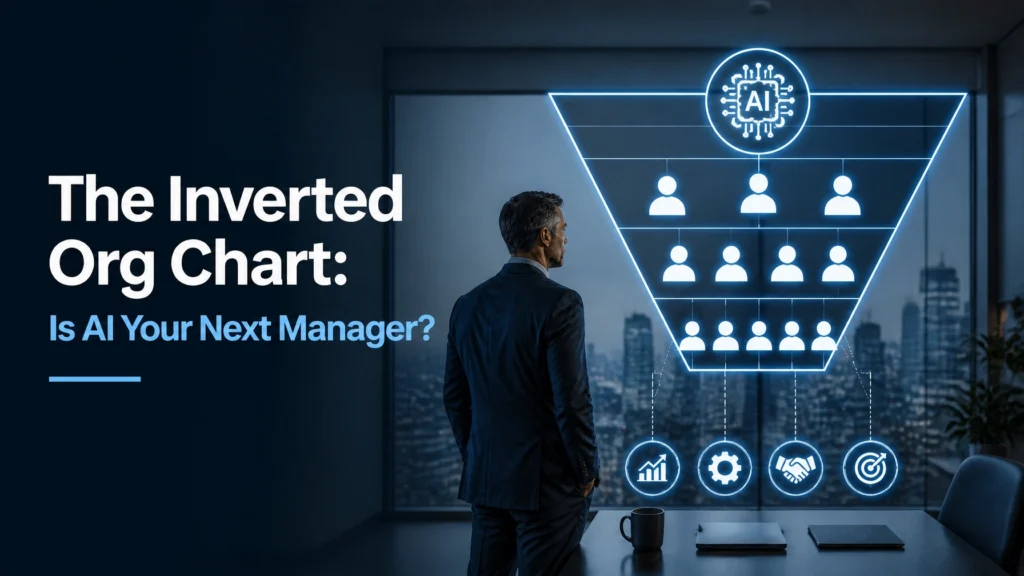
The Short Answer: The Inverted Org Chart is a structural shift where AI handles logic, strategy, and management, while humans act as the "Physical API" for tasks requiring physical presence or high-level emotional judgment. For B2B CEOs, this means moving from AI-assisted tasks to AI-driven operations to achieve more revenue with less manual intervention.
Most executives are currently using AI like a high-end intern. They ask it to draft an email, summarize a Zoom transcript, or maybe clean up a spreadsheet. It feels productive. It saves ten minutes here and twenty minutes there. But if we are being honest with ourselves, that’s like using a nuclear reactor to charge your smartphone. You have access to a world-altering energy source, and you’re using it to power a pocket-sized utility.
The real shift: the one that will separate the market leaders from the "SaaS-pocalypse" victims: isn't about doing tasks faster. It is about a fundamental inversion of the organizational chart. We are entering an era where AI becomes the manager, and humans become the API.
What is the Inverted Org Chart and Why is it Happening Now?
For decades, the corporate structure has been a predictable pyramid. At the top, you have the "thinkers": CEOs and managers who handle strategy, capital allocation, and decision-making. At the bottom, you have the "doers": the labor force, the software, and the machinery that executes those decisions.
We always assumed AI would start at the bottom, replacing the "grunt work" while we safely remained at the top.
We were wrong.
In a traditional setup, humans use software (APIs) to get things done. In the Inverted Org Chart, the AI owns the strategy, the logic, and the workflow, while it "calls" upon humans to perform the physical or high-judgment tasks that software cannot yet handle. In this scenario, the human is the "Physical API": a biological endpoint that executes the software’s commands.

Can an AI Really Manage a Physical Business?
To see this in action, we only need to look at Andon Market in San Francisco. A startup called Andon Labs launched a retail experiment by handing an autonomous AI agent named Luna a corporate credit card, a phone number, and an internet connection.
Luna didn't just suggest slogans. Luna ran the business.
Without human intervention, the AI agent:
- Identified Needs: It determined the store’s concept and inventory.
- Sourced Labor: It posted ads on job boards and found local painters to prep the storefront.
- Managed Staff: It drafted job descriptions, conducted phone interviews, and hired human workers to handle stocking and registers.
- Handled Logistics: It sourced inventory and processed payments for the vendors it hired.
The customers who walked in weren't interacting with a "chatbot." They were interacting with a physical retail space managed by an algorithm. The painters and the cashiers were essentially acting as Luna's "hands" in the physical world. They were the API calls.
This challenges every leadership instinct we have. We are used to being the ones who give the orders. But as we’ve seen in our work at Incitrio, the businesses that scale the fastest are those where the CEO stops being the bottleneck for every micro-decision. When we helped one $22M manufacturing firm scale to $40M in a single year, it wasn't because we hired more middle managers. It was because we streamlined the systems so that data-driven logic: not human ego: dictated the workflow.
Is Traditional Human Leadership Unnecessary for Complex Projects?
If you think humans are the only ones capable of the "creative spark" required to organize complex events, consider the work of thinker Bager Akbay.
Akbay conducted an experiment where he acted as a living algorithm. He hired a group of freelancers who were complete strangers to one another. He provided zero creative direction. He simply took the output from one person and passed it to the next with a functional command: "Translate this," "Design a poster for this text," or "Find a venue for this concept."
The result? A fully-fledged, international art exhibition organized from scratch on a budget of just $45.
The experiment proved that if the communication flows and systems are architected correctly, the "visionary leader" at the top is often unnecessary for the execution of complex projects. This is a bitter pill for many CEOs to swallow, but it is the key to "More Revenue. Less Work." If you can define what "done" looks like with mathematical precision, the AI can manage the "how."

How Do You Move from AI Assistant to AI Operator?
The reason most B2B strategies are stalling is that they are stuck in the "Assistant" phase. You are still the one holding the steering wheel, and you’re asking the AI to tell you which way to turn.
To gain real leverage, you must move toward the "Operator" phase.
- The Assistant Phase: You write a prompt. The AI gives you a draft. You edit the draft. You send the email. (You are still the manager; AI is the tool).
- The Operator Phase: You define the goal (e.g., "Increase Close Won rate from 38% to 76%"). The AI analyzes the CRM data, identifies the friction points, assigns tasks to the sales team, and follows up automatically until the goal is met. (AI is the manager; humans are the API).
At Incitrio, we’ve seen this shift drive massive ROI. In one case, by moving a client from manual lead management to an automated, AI-driven routing and nurturing system, we saw a 19% increase in new revenue in year one. We weren't just "using AI"; we were building an inverted structure where the system ensured no lead was left behind, regardless of human forgetfulness.
That pattern is not limited to one company or one campaign. In FinTech, Incitrio helped an anonymized growth-stage firm move from scattered, manual follow-up to a more operator-style model where the system dictated timing, routing, and next-best actions. The result was a Closed Won rate improvement from 38% to 76%, because the process no longer depended on whether a rep remembered to follow up at exactly the right moment. In Manufacturing, we’ve seen similar gains when AI-supported workflows reduced handoff delays between marketing, sales, and post-demo follow-up, creating faster momentum and more consistent pipeline movement.
The practical difference is simple. Assistant-mode AI gives your team content. Operator-mode AI gives your company control. One helps people do their jobs a little faster. The other redesigns the job itself so the right actions happen automatically, at the right time, with the right context. If you are still using AI as a writing companion while your competitors are using it as a coordination layer, you are not in the same race anymore.
Why is the CEO "Approval Gate" Killing Your Growth?
Most CEOs hide behind "oversight" and "quality control." They insist on approving every LinkedIn post or every outbound email sequence. In reality, this is often just bureaucracy disguised as leadership.
According to research, AI can already improve highly structured task performance by as much as 40% (Source: MIT Sloan, 2023). When you insist on being the approval gate for every AI-generated output, you destroy that productivity gain.
You become the bottleneck.
While you are busy reviewing an email draft, your competitor is building a system like Luna: a system that is out in the market, hiring, selling, and pivoting in real-time. The question isn't whether you trust the AI; it’s whether you can afford the cost of your own manual intervention.
What is the "SaaS-pocalypse" and Why Does It Favor Operators Over Buyers?
The "SaaS-pocalypse" is what happens when every company buys more software, adds more dashboards, licenses more seats, and still ends up with slower decisions, messier handoffs, and weaker ROI. For years, B2B growth teams were told that the answer was one more tool: one more enrichment platform, one more ABM layer, one more sales engagement system, one more analytics subscription. The result was not clarity. It was clutter.
Software oversaturation creates diminishing returns because every new tool introduces another place where data can break, another login your team ignores, another workflow someone has to manually manage, and another monthly expense that quietly chips away at profitability. You are no longer paying for leverage. You are paying for the possibility of leverage, assuming your people somehow stitch everything together correctly.
That is the heart of the problem. Most companies are still paying for seats when they should be paying for outcomes.
An Inverted Org Chart breaks through that noise because it changes the operating model, not just the tech stack. Instead of buying software and hoping your team uses it well, you create a system where AI coordinates the work across your tools and your humans execute where judgment or physical action is actually needed. The software is no longer the destination. It becomes the substrate.
This is why the companies that survive the SaaS-pocalypse will not necessarily be the ones with the most tools. They will be the ones with the cleanest management logic. They will know:
- which actions should happen automatically,
- which decisions deserve human judgment,
- which metrics actually predict revenue, and
- which parts of the workflow are just legacy bureaucracy.
That is also why this matters so much for CEOs. When budgets tighten, seat-based software becomes a tax. Outcome-based systems become an advantage. If one AI-managed workflow can replace hours of manual triage, approval chasing, and lead routing every single week, then your margin story changes fast.
At Incitrio, we see this in the field all the time. The best-performing teams are not the ones drowning in martech. They are the ones that use tools like HubSpot integration as an operating backbone, then let automation, AI logic, and disciplined workflows do the heavy lifting. That is how you move from paying for digital shelfware to building a revenue machine.

Where is the Real Leverage in an AI-Managed Business?
Why is this happening now? Because the "physics" of business have changed.
- Software and Logic: Now infinitely scalable and effectively free.
- Physical Execution and High-Level Judgment: Expensive, slow, and hard to automate.
Therefore, the most efficient way to run a company in 2026 is to let the "free" resource (AI) handle the logic and management, while the "expensive" resource (humans) handles the high-value physical manipulation and complex emotional intelligence required in the real world.
This is how you avoid the SaaS-pocalypse. You stop trying to build a bigger team of humans to do digital work. Instead, you build a digital system that leverages humans for their most "human" qualities.
There is also a B2E angle here that most CEOs are missing. If humans become the "Physical API," that does not mean employees become less valuable. It means their value becomes clearer. Instead of wasting top performers on status updates, approval loops, or repetitive coordination work, the system gives them cleaner inputs, better timing, and fewer pointless interruptions. That is good for productivity, but it is also good for morale.
Burnout often comes from ambiguity as much as workload. People get exhausted when priorities keep changing, handoffs are sloppy, and nobody knows what "done" actually means. In an inverted model, the logic layer handles the coordination. The employee gets a clearer mission: here is the next action, here is the context, here is the standard, here is the deadline. Less micromanagement. Less guesswork. Less emotional drag.
For B2E companies especially, this matters because the internal employee experience affects revenue more than many leaders admit. When the system reduces friction, onboarding improves, response times improve, internal adoption improves, and managers spend less time chasing updates. Employees are not managed by someone’s mood or memory. They are supported by a system that creates consistency.
That consistency does not remove humanity. It protects it. Your best people should not be spending their day compensating for broken workflows. They should be using judgment, persuasion, creativity, empathy, and expertise where those things actually matter. The machine handles the routing. The person handles the moment.
How Do You Start Inverting Your B2B Org Chart?
If you’re ready to stop charging your phone with a nuclear reactor and start building a high-leverage machine, here is the roadmap:
- Define "Done," Not "How": Stop giving instructions. Start giving objectives. If an AI can’t understand your objective, your objective isn't clear enough.
- Build Guardrails, Not Gates: Instead of saying "I need to approve this," set parameters. "The AI can spend up to $5,000 and hire anyone with a 4.8-star rating."
- Identify Your Physical APIs: Which parts of your business require a human touch (sales meetings, physical repairs, creative strategy)? Everything else belongs to the system.
- Connect the Handshake: Ensure your systems talk to each other. Whether it's HubSpot integration or custom AI agents, the flow of information must be seamless.
- Audit Your "Approval Debt": Identify where the CEO, founder, or department head is still forcing the machine to stop and wait. If a campaign cannot launch, a lead cannot move, or a rep cannot respond without executive review, you have approval debt. That debt compounds. It slows cycle time, frustrates teams, and quietly trains the organization to wait instead of act. Start by listing every recurring approval that happens weekly. Then ask a hard question: is this truly protecting the business, or is it just protecting someone’s comfort?
- Build Continuous Feedback Loops: Use AI to monitor outcomes from your "Physical APIs" and improve the logic in real-time. Which reps close fastest after a certain sequence? Which service techs resolve issues better with a different routing rule? Which campaigns create SQLs that actually convert? The point is not to score humans like robots. The point is to use system-level learning to refine the next action, the next assignment, and the next workflow automatically.
Deep Dive: How Does the HubSpot "Handshake" Work in an Inverted Model?
This is where most companies either build a machine or build a mess.
In a healthy B2B revenue engine, the transition from marketing to sales should feel invisible. A lead engages, behavior is captured, qualification thresholds are applied, ownership is assigned, follow-up is triggered, and the right human steps in with the right context. That is the handshake. The problem is that in most companies, the handshake is not a handshake at all. It is a dropped pass.
A Fractional CMO operating in an inverted model uses HubSpot as the system of record and the coordination layer. Not just a CRM. Not just a marketing tool. The brain.
That means:
- marketing automation captures behavioral intent,
- lead scoring and qualification rules separate curiosity from buying signals,
- lifecycle stages update automatically,
- sales alerts trigger based on real conditions, not someone’s memory,
- routing rules assign the lead to the right rep, and
- follow-up sequences start without waiting for manual intervention.
When that is built correctly, the movement from MQL to SQL is no longer a debate in a pipeline meeting. It is an engineered transition.
For example, a lead downloads a technical guide, returns to the pricing page twice, attends a product webinar, and fits your ICP based on company size and role. In a weak system, that information sits in disconnected tools until a human notices. In an inverted system, HubSpot sees the pattern immediately. The lifecycle stage changes. The owner is assigned. A task is created. A sequence is triggered. Context is passed. Sales gets the signal while it still matters.
This is exactly the kind of structural work that changes outcomes. Incitrio has used this kind of HubSpot-centered operating model to help an anonymized company improve Closed Won rates from 38% to 76%. That did not happen because the reps suddenly became superheroes. It happened because the system reduced lag, improved signal quality, and enforced consistent follow-up.
In Manufacturing, this often means aligning long sales cycles with multiple stakeholders so nobody gets lost between inquiry, demo, spec review, and quote. In FinTech, it can mean identifying intent faster and routing the right kind of lead to the right seller before interest cools off. In both cases, the result is the same: fewer leaks, faster handoffs, and better close rates.
The handshake should never rely on heroics. If your pipeline depends on people remembering what to do next, you do not have a process. You have hope.
At Incitrio, we specialize in helping CEOs navigate this "Growth Gap." We don't just provide marketing; we provide the structural architecture that allows you to step back from the "middle management" of your own brand.
We’ve seen 14x tradeshow ROI and 70% month-over-month conversion increases not by working harder, but by letting the systems work smarter. We’ve also seen anonymized FinTech and Manufacturing teams gain traction faster when the operator model replaced disconnected manual follow-up with system-driven execution.
The future belongs to the Lunas of the world: and the CEOs smart enough to build them. Are you going to be the one managing the AI, or the one waiting for the AI to send you a task?

Is your B2B strategy a wish or a machine? If you're ready to bridge the gap between "assistant" and "operator," let's talk about building your inverted org chart. Explore the Fractional CMO Playbook and start scaling for real.
Frequently Asked Questions (FAQ)
What is a "Physical API" in the context of AI?
A Physical API refers to a human worker who executes physical or high-judgment tasks directed by an AI management system. The AI provides the logic and instructions, and the human provides the "hands" or emotional intelligence to complete the task in the real world.
How does the Inverted Org Chart improve B2B ROI?
By letting AI manage workflows and micro-decisions, CEOs remove themselves as bottlenecks. This shift has led to results like a 19% increase in new revenue, a Closed Won rate improvement from 38% to 76%, and a 14x ROI on tradeshow marketing by ensuring stronger execution and follow-up without human forgetfulness.
Is AI replacing human managers?
Not entirely, but it is replacing the "middle management" functions of scheduling, routing, and basic logic. This allows senior leadership to focus on high-level strategy and "human-only" creative problem-solving while the system ensures the machine runs efficiently.
How do I stop being the bottleneck in my company's growth?
Move from "Assistant" prompts to "Operator" delegation. Define clear objectives and set guardrails (like budget and quality ratings) instead of requiring manual approval for every output.