
Let’s have a "closed-door" conversation for a minute. You’re a CEO. You’ve got a solid product, a decent sales team, and a vision that could conquer your niche. Yet, when you look at the quarterly numbers, they aren’t "conquering." They’re… fine. Maybe they’re even growing, but it feels like you’re pushing a boulder up a hill rather than riding a wave.
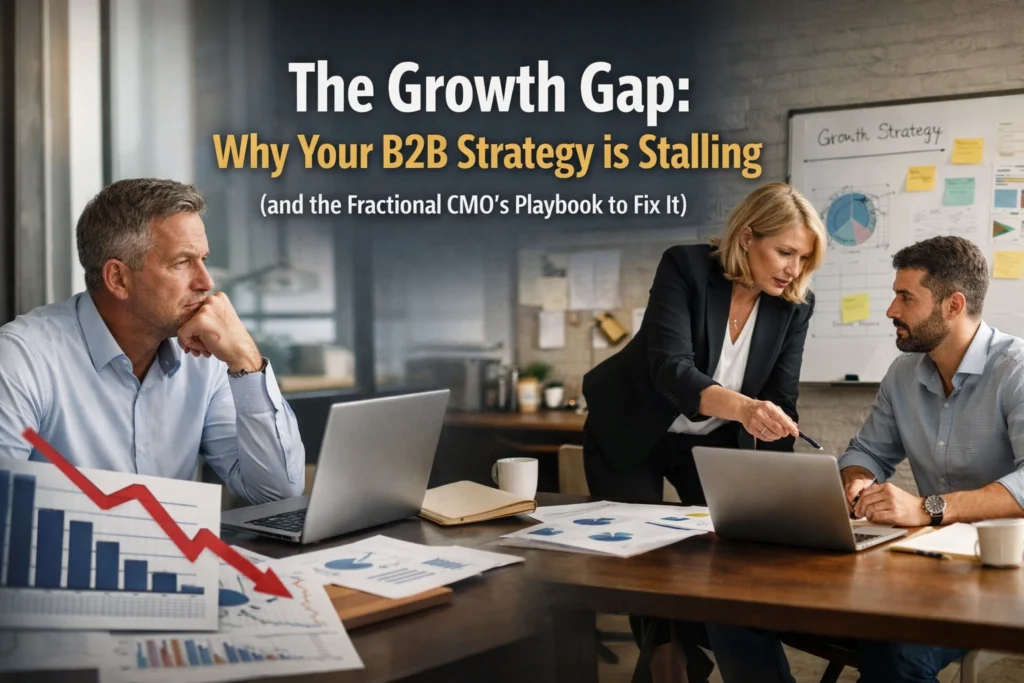
If that sounds familiar, you’re caught in the Growth Gap.
I recently dug into some heavy-hitting research from McKinsey (specifically a deep dive with Greg Kelly and Jill Zucker), and the data confirms what I’ve been seeing on the ground at Incitrio: Most leaders want to grow, but almost none of them have the systems to actually make it happen.
We’re going to bridge that gap today. I’m stripping away the consultant-speak to give you the no-fluff playbook on how to turn your growth "intent" into sustained, profitable performance.
The 72% vs. 22% Problem: Mindset is Not Enough
The "Answer-First" Takeaway: The primary reason B2B growth stalls is a disconnect between executive ambition and operational readiness. While 72% of leaders aspire to run a high-growth company, only 22% have actually allocated the talent and resources to achieve it.
According to McKinsey, the "Growth Mindset" is the holy grail, but it’s also a trap. Why? Because mindset without muscle is just a wish. Jill Zucker points out that while the majority of CEOs wake up wanting to grow, they fail to back that up with the same rigor they apply to cost-cutting.
Think about it: When you need to cut costs, you have spreadsheets, weekly audits, and clear accountability. But when it comes to growth? It’s often "let’s try this campaign" or "let’s hope the sales team steps it up." That’s not a strategy; that’s a prayer.
Why the Gap Exists
- The Urgent Overwhelms the Important: COVID, tariffs, supply chain issues: there’s always a fire to put out. Only 30% of leaders actually increase resources for growth during uncertainty.
- Lack of Systematic Tracking: Most companies don't have a feedback loop to see which growth initiatives are actually moving the needle.
- The Talent Void: Growth requires your best people to work on the "new and scary" stuff, but most CEOs keep their A-players tethered to the "safe and steady" core business.

The 5 Mindsets of the Growth Leader
To fix the gap, you have to adopt five specific mindsets that McKinsey identified as the drivers of outperformance. But here’s the Angela Hill version: it’s not just about thinking differently; it’s about acting differently.
1. Prioritizing Growth (The "Active Choice")
Growth is a choice you make every day. It’s not a byproduct of "doing a good job." It requires deliberate bets. If you aren't looking at your calendar and seeing significant blocks of time dedicated to long-term growth initiatives, you aren't prioritizing it. You’re just managing the status quo.
2. Acting Boldly (Especially When It Smarts)
Greg Kelly notes that outperformers stay courageous during downturns. Take Corning, for example. They set a goal for $3 billion in new annualized sales during a volatile period by accelerating innovation in Gen AI. They didn’t retreat; they leaned in. As a CEO, your job is to be the "Chief Conviction Officer."
3. Real Customer Centricity (Not Just Surveys)
Here’s a staggering stat: 63% of companies collect customer data, but only 15% use it to make growth decisions.
If your "customer centricity" is just an NPS score in a slide deck, you’re failing. Real centricity means using data to change your product, your messaging, and your delivery. (Think Sephora’s "Color IQ": they used AI to solve a specific, personal customer pain point, which drove massive loyalty).
4. Attracting and Nurturing Talent
You need a team "wired for growth." This means taking your high performers and putting them in nascent, unproven areas. It’s risky, and it takes courage. If you only put your best people on your biggest existing accounts, you’re effectively capping your future.
5. Executing with Rigor
This is where the wheels usually fall off. You need to apply the same "cost-cutting discipline" to your growth funnel. What’s happening every week? Where is the pipeline stalling? If you don’t have data at every step of the funnel, you aren't executing; you’re guessing.
The 15% Paradox: Why Your Data is Lying to You
The "Answer-First" Takeaway: Data collection is a commodity; data application is a competitive advantage. Companies that bridge the gap between "having data" and "acting on data" see disproportionate growth.
Jill Zucker highlighted a massive failure mode in B2B: the feedback loop. CEOs pride themselves on being in the field, talking to clients. But that "field intel" rarely makes it back into the strategy in a systematic way.
If you’re a CEO in the $20M-$500M range, you probably have a CRM (like HubSpot or Salesforce) full of data. But is that data telling you where your next $10M is coming from, or is it just a digital Rolodex? At Incitrio, we see this all the time. Companies have the "what" (data), but they lack the "so what" (insight) and the "now what" (action).
How to Move from 15% to the Top Tier:
- Integrated Feedback Loops: Sales feedback must inform marketing spend in real-time.
- Predictive Analytics: Move away from "what happened last month" to "what is likely to happen next quarter."
- The "Agentic" Shift: Using AI to analyze sentiment and churn before the customer even knows they’re unhappy.
2026: The Year of the "Agentic" Organization
We are moving past the "AI is a chatbot" phase. Greg Kelly and the McKinsey team are calling 2026 the year of Agentic AI.
What does that mean for you? It means AI is moving from "helping humans write emails" to "acting as an autonomous agent for growth."
- Lead Gen on Autopilot: Agents that don't just find leads but nurture them, qualify them, and book the meeting based on complex criteria.
- Hyper-Personalized Coaching: AI that listens to your sales calls and gives real-time, tailored advice to your reps to close the gap between your best and worst performers.
- Churn Reduction: Agents that scan customer behavior across digital channels and trigger retention plays automatically.
If you aren't rewiring your organization to absorb these agentic capabilities now, you’re going to be left behind by competitors who are scaling without the $300k-per-head overhead.

The "Green Light" Culture: Protecting Your Risk-Takers
One of the most profound points in the McKinsey discussion was about talent management. If you want growth, you need people willing to take risks. But if you fire the executive when a "growth bet" doesn't pay off, no sane person will ever take a risk for you again.
The CEO's Role: You must set the tone.
- Avoid the "Red Light" Trap: In many companies, everything is "green, green, green" until it suddenly hits "burning red." That happens because people are afraid to give a warning light.
- Collective Problem Solving: When a growth initiative stalls, it shouldn't be a punitive conversation. It should be: "Let’s solve this together. Do we need more dollars, more talent, or a change in direction?"
- The Cadence of Renewal: Every 3-5 years, you need to refresh your vision. Don't rest on your laurels. Bring in fresh talent to drive new initiatives and "re-underwrite" your bets.
The Fractional CMO: The Catalyst for This Transformation
Let’s be honest: Most CEOs of mid-market companies don't have the time to build these rigorous growth systems themselves. And hiring a full-time, high-level CMO can cost $300k+ once you factor in benefits and equity.
This is where the Fractional CMO comes in. Think of us as the "Growth Architect" who bridges the 72% (intent) and the 22% (action).
How a Fractional CMO Fixes the Stalled Strategy:
- Immediate Strategic Rigor: We bring the "cost-cutting discipline" to your marketing. No more "spray and pray." Everything is tracked, audited, and optimized.
- Objectivity: We aren't entrenched in your internal politics. We see the "ghost leads" and the wasted spend that your internal team might be blind to.
- High-Level Talent Without the Overhead: You get the McKinsey-level strategy at a fraction of the cost of a full-time C-suite hire.
- Executing the "Agentic" Shift: We don't just talk about AI; we implement the tools and workflows to turn your CRM into a revenue engine.
If you’re tired of "hoping" for growth and ready to start engineering it, it might be time to look at how a Fractional CMO can reorganize your "Growth Gap" into a "Growth Engine." Check out our guide on 7 mistakes you're making with your fractional CMO to see how to do it right.
Comprehensive Growth Strategy FAQ
What is the "Growth Gap"?
The Growth Gap is the discrepancy between a leader’s desire to grow (72% of executives) and their actual allocation of resources and talent to achieve that growth (only 22%). It’s the space where strategy goes to die because of a lack of execution rigor.
Why do most B2B growth strategies fail?
Most fail because they lack the same discipline applied to cost management. Without weekly tracking, clear KPIs, and a willingness to "re-underwrite" initiatives that aren't working, growth becomes a matter of luck rather than a repeatable process.
How does Agentic AI differ from regular AI?
Regular AI (like basic ChatGPT) helps with tasks. Agentic AI acts as an "agent": it can execute multi-step processes autonomously, such as lead qualification, sentiment-driven customer service, and real-time sales coaching, moving from "promise" to "scale" in 2026.
What is "re-underwriting" a growth initiative?
This is the practice of looking at a 3-year growth bet at the 18-month or 24-month mark and asking: "Based on what we know today, would we still make this bet?" It prevents "sunk cost fallacy" and allows for course correction in a volatile market.
When should a CEO hire a Fractional CMO instead of a full-time one?
A Fractional CMO is ideal for companies between $20M and $500M that need executive-level strategy but aren't ready for the $300k+ annual overhead. It’s also the perfect move for companies that have hit a plateau and need an objective expert to audit and "rewire" their growth engine.

Final Thought: The Tone Starts with You
At the end of the day, growth is a human endeavor powered by technology. As the CEO, you set the "cadence of renewal." You decide if February is "Growth Month" or if it’s just another month of putting out fires.
Don't let your 2026 be another year of "intent." Let’s make it the year of action.
Ready to bridge the gap? Let's talk about how Incitrio can help you scale.