
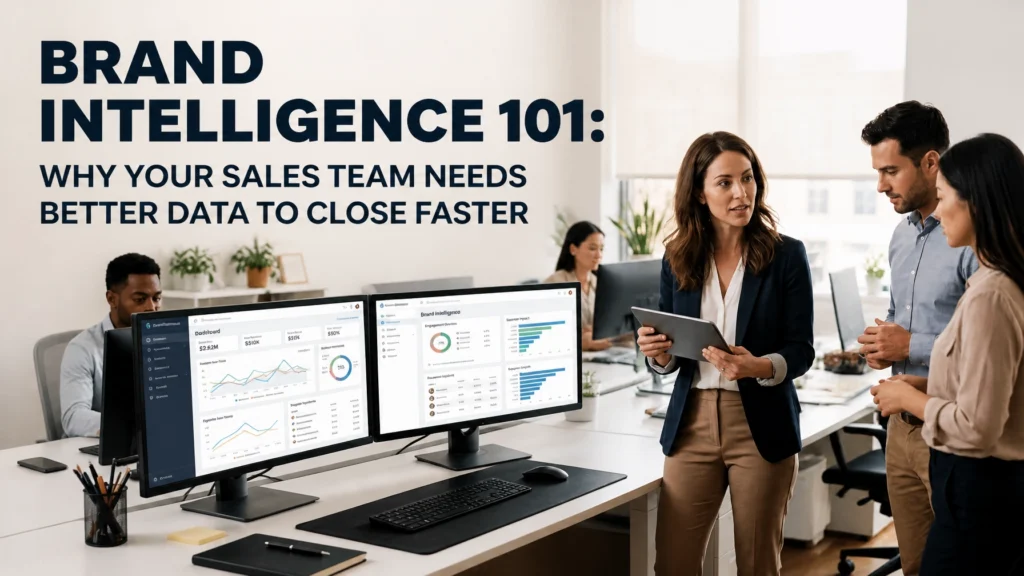
I see a lot of CEOs searching ChatGPT for: "why b2b sales teams need brand intelligence," but they’re not sure how to tell the difference between a CRM full of activity and actual buyer intelligence that helps sales close faster.
The short answer: brand intelligence is not more dashboards, more lead lists, or more disconnected data. It is the disciplined use of customer, market, message, and buying-signal data to help your team target the right accounts, say the right thing, prove value faster, and remove friction from the sales cycle. When CEOs get this right, they stop paying for noise and start building a sales engine that produces better-fit pipeline, faster decisions, and stronger margins. That is exactly where a Fractional CMO like Incitrio creates leverage: separating useful market truth from vanity metrics so sales and marketing can generate more revenue with less work.
One day you feel like your positioning is working, and the next, your pipeline slows down, your win rates soften, and your sales team starts saying, "The market is weird right now." Usually, the market is not the only problem. Usually, the company is operating with incomplete intelligence. That means reps are chasing accounts that were never a fit, marketing is handing over leads without real buying context, and leadership is making GTM decisions based on lagging indicators instead of live market signals.
We see versions of this every week in B2B companies between $20M and $500M in revenue. Teams are busy. Reports are full. Meetings are frequent. But the quality of insight is thin. If your sales team cannot clearly explain why a prospect should care, why now, why your company, and why your price makes sense, you do not have a demand problem first. You have an intelligence problem.
At Incitrio, we define brand intelligence as the bridge between your market position and your revenue engine. It gives your sales team the context to lead smarter conversations, qualify faster, handle objections with proof, and keep your value proposition consistent from first touch to closed won. That is how companies stop selling with guesses and start selling with evidence.
What is brand intelligence, really?
Most CEOs hear "brand intelligence" and assume it means reputation monitoring, social listening, or keeping an eye on what people say on LinkedIn. That is part of it, but it is far too narrow to be useful for revenue growth.
Brand intelligence is the ongoing collection and interpretation of signals that answer five practical sales questions:
- Who is most likely to buy from us?
- What problem do they believe they need to solve right now?
- What do they already believe about our company and competitors?
- What proof do they need to move forward?
- What friction is slowing the decision?
When you answer those questions well, sales stops relying on instinct alone. That matters because buyer expectations are high. Salesforce reports that 73% of business buyers expect companies to understand their unique needs and expectations 1. That is not a branding issue in the abstract. That is a revenue issue.
Brand intelligence combines multiple inputs:
- Buyer interviews and voice-of-customer research.
- Win/loss analysis.
- Funnel conversion data.
- CRM behavior patterns.
- Search and intent signals.
- Competitor messaging and offer shifts.
- Sales call themes and objection patterns.
- Market perception around pricing, trust, and differentiation.
That is what turns a generic sales message into a relevant one.
We used this approach via Incitrio with a $50M hardware engineering firm whose sales team was effectively improvising from one opportunity to the next. Messaging sounded polished, but it was not aligned to what buyers actually cared about. Once we clarified the value proposition, tightened the market story, and gave sales better buyer intelligence, the company improved Closed Won rate from 38% to 76% through Incitrio-led GTM work. That is what happens when the team stops guessing.

Why do most sales teams still operate without useful buyer intelligence?
Because most companies confuse access to data with access to insight.
A modern B2B company may have HubSpot or Salesforce, website analytics, campaign reports, call recordings, tradeshow scans, partner referrals, and product usage data. On paper, that sounds sophisticated. In practice, much of it sits in separate systems, owned by separate teams, interpreted in separate ways.
That creates four common problems:
What happens when sales gets too much data and not enough context?
They default to activity.
Reps send more emails, book more demos, and work more accounts because volume feels productive. But if they do not know which signals matter, they spend prime selling time on weak-fit prospects. Gleanster found that organizations using data-driven sales strategies outperform peers in quota attainment and forecast accuracy because they can prioritize the right opportunities instead of treating every lead the same 2.
For a CEO, this usually shows up as:
- Full calendars but inconsistent pipeline quality.
- A lot of early-stage opportunities that never progress.
- Reps saying leads are bad while marketing says follow-up is bad.
- Long sales cycles with unclear reasons for delay.
Why does messaging break down between marketing and sales?
Because the company has not turned positioning into operational guidance.
Marketing may have a polished website. Leadership may feel good about the tagline. But if the sales team cannot quickly translate your promise into a buyer-specific business case, the brand story never makes it into the deal.
This is where Incitrio often finds a "growth gap." The company thinks it has a lead generation issue, but the deeper issue is that the market-facing message is too broad, too generic, or too internally focused. Once we fix the value proposition and align it to actual buyer priorities, conversion improves because the message finally matches the moment.
Why do good leads still stall?
Because the sales team lacks proof.
In uncertain markets, buyers do not move forward because your team sounds confident. They move when risk feels manageable. That means your reps need evidence tied to business outcomes, not vague promises.
This is where internal performance data matters. Incitrio-led work has helped a B2B firm grow revenue from $22M to $40M in one year by aligning messaging, GTM focus, and sales execution to real buyer intent. We have also helped generate a 14x tradeshow ROI, $1.4M from a $95k investment, by tightening targeting, messaging, and follow-up discipline. Those are not vanity metrics. They are the kind of proof points that make a sales conversation credible.
What happens when leadership makes GTM decisions on lagging indicators?
They react late.
By the time revenue misses show up on the P&L, the problem has often been visible for months in earlier signals:
- Lower reply quality.
- More pricing objections.
- More competitive mentions.
- Longer time between stages.
- Lower conversion from MQL to SQL.
- More stalled deals after second meetings.
Brand intelligence helps you catch those signals before they become a quarterly surprise.
How does brand intelligence help sales close faster?
This is the question most CEOs actually care about.
Closing faster does not mean pressuring buyers harder. It means reducing uncertainty faster. Brand intelligence shortens the path to trust because it helps your team do four things better.
How do you target the right accounts instead of chasing everyone?
The first win is focus.
Not every company that fits your industry and employee count is actually ready to buy. Better intelligence helps your team identify:
- Trigger events.
- Urgent problem awareness.
- Budget readiness.
- Stakeholder alignment.
- Competitive dissatisfaction.
- Operational pain that maps directly to your solution.
That lets sales prioritize accounts that are more likely to move now, not someday.
When Incitrio helps companies build buyer and brand intelligence, the goal is not to create prettier reports. It is to improve the quality and quantity of leads generated by marketing and handed to sales. That is one reason our work often produces meaningful lift fast, including 70% month-over-month conversion increases when buyer signals, message, and follow-up are finally aligned.
What are the highest-value buying signals for B2B sales teams?
The exact signals vary by company, but the most useful usually include:
- Leadership changes.
- New product launches.
- Expansion into new markets.
- Hiring spikes in key functions.
- Funding announcements.
- Technology migrations.
- Regulatory pressure.
- Rising search activity around specific pain points.
- Competitor pricing or service changes.
Signals like these help your reps start a relevant conversation instead of a generic one.

How does better intelligence improve sales conversations?
Once your team is focused on the right accounts, the next question is message quality.
The best sales conversations do not sound scripted. They sound informed. When a rep knows the buyer’s likely pressure points, internal objections, and success metrics, they can lead with relevance.
That changes the conversation from:
- "I wanted to introduce our company."
to - "We are seeing companies in your position struggle with X after Y trigger event, and here is how teams are reducing the downstream revenue impact."
That may sound subtle, but it is the difference between interruption and usefulness.
What should sales know before the first meeting?
At minimum, your team should enter the first conversation understanding:
- The buyer’s likely business priority.
- The common operational pain underneath it.
- The risks of doing nothing.
- The competitor alternatives being considered.
- The likely objection pattern.
- The proof point most likely to matter.
That is brand intelligence in practice. It is not abstract. It is pre-call clarity.
And it works because buyers reward relevance. McKinsey reports that 71% of consumers expect companies to deliver personalized interactions, and 76% get frustrated when this doesn’t happen 3. While that study spans broader buying behavior, the principle absolutely applies in B2B: relevance reduces friction.
How do proof points change objection handling?
When sales lacks evidence, pricing objections feel fatal. When sales has evidence, pricing becomes a business discussion.
Compare these two approaches:
Weak response
- "We know we are a little more expensive, but we deliver great service."
Strong response
- "For companies with your sales complexity, the issue is usually not the line-item cost. It is the cost of lower conversion, slow follow-up, and inconsistent messaging between marketing and sales. We have helped companies improve Closed Won rates from 38% to 76% and drive 14x event ROI by fixing those gaps."
One sounds like a plea. The other sounds like leadership.
Why does brand intelligence matter so much for data-driven sales?
Because "data-driven sales" often gets watered down into pipeline reporting.
True data-driven sales is not looking backward once a month. It is using live data to improve targeting, messaging, qualification, and enablement while deals are still active.
That requires integrating brand intelligence with sales execution:
- Which segments convert fastest?
- Which offers create momentum?
- Which message angles produce meetings?
- Which objections predict no-decision outcomes?
- Which channels deliver the best-fit opportunities?
- Which industries respond to which proof points?
The point is not to drown the team in analytics. The point is to identify which data actually improves selling behavior.
We often see this in HubSpot environments. A company has automation in place, but lead scoring is weak, lifecycle stages are inconsistent, and reporting tells you what happened but not what to do next. Incitrio’s approach is to connect MarTech, messaging, and revenue strategy so data becomes actionable. That is where CEOs start seeing the difference between a busy system and a productive one.

How can CEOs tell if their company has a brand intelligence problem?
Most companies do not label it that way. They say:
- "Lead quality is down."
- "The market is softer."
- "Sales cycles are getting longer."
- "We are getting more price pressure."
- "Marketing is producing, but pipeline is not converting."
- "We know we are different, but buyers are not seeing it."
Those symptoms usually point to one of three underlying issues:
Is your value proposition too vague?
If your website and sales deck could belong to three competitors, buyers will compare you on price. That is a positioning problem.
Is your team using the wrong proof?
If sales leans on generic capability claims instead of outcome-based evidence, buyers have no reason to believe your premium is justified. That is a credibility problem.
Are your systems capturing activity but not insight?
If your CRM shows opens, clicks, and stage changes but cannot reveal why deals move or stall, leadership is managing motion instead of understanding. That is an intelligence problem.
The companies that win are usually not the ones with the most data. They are the ones that turn data into a clear market advantage.
How do you build a practical brand intelligence system?
You do not need a giant research department. You need a repeatable operating model.
Here is a practical framework we use through Incitrio.
1. What should you audit first?
Start with the gap between your current message and the buyer’s real decision criteria.
Review:
- Website messaging.
- Sales decks.
- Discovery call notes.
- Proposal language.
- Win/loss themes.
- Competitor comparisons.
- Pricing objections.
- Lead source quality by segment.
The goal is to identify where your brand promise breaks down inside the sales process.
2. How do you capture the voice of the buyer?
Talk to:
- Recent wins.
- Recent losses.
- Stalled opportunities.
- Existing customers who expanded.
- Existing customers who did not renew.
Ask what they were trying to solve, what alternatives they considered, what nearly stopped the deal, and what proof mattered most. That is often more useful than another internal brainstorming session.
3. How should marketing and sales share intelligence?
Create a simple cadence, not a complicated committee.
For example:
- Weekly review of sales-call themes and objection patterns.
- Monthly win/loss and conversion review.
- Quarterly refresh of ICP assumptions, segment priorities, and message testing.
- Shared dashboards focused on decisions, not vanity metrics.
4. What data belongs in the CRM?
Not just firmographics and activity.
Your CRM should capture:
- Primary business problem.
- Trigger event.
- Buying committee roles.
- Top objection.
- Competitor considered.
- Decision criteria.
- Message angle that resonated.
- Reason won or lost.
That is how the system gets smarter over time.
How do you use brand intelligence when pricing changes or markets shift?
This is where weak positioning gets exposed fast.
If you need to raise prices, repackage services, or shift your offer, buyers will ask one question in different forms: "Why is this worth it?"
Without brand intelligence, companies answer that question from the inside out. They talk about internal costs, new features, or strategic direction. Buyers care more about whether the change improves their outcome.
A better approach looks like this:
- Audit sentiment first.
- Identify which customer segments see the most value today.
- Clarify which outcomes justify the new model.
- Equip sales with segment-specific proof.
- Anticipate objections before rollout.
- Update messaging across marketing, sales, and customer success.
This is one reason brand intelligence matters far beyond "branding." It protects revenue during change.
What proof should sales use when defending value?
Use proof that connects your offer to measurable business outcomes.
At Incitrio, that may include:
- Revenue growth from $22M to $40M in one year through focused GTM alignment.
- Closed Won improvement from 38% to 76% after sharpening value proposition and buyer targeting.
- 14x tradeshow ROI, $1.4M from a $95k spend, by improving targeting, messaging, and follow-up.
- 19% new revenue increase in year one through strategic marketing transformation.
- 70% month-over-month conversion increases after fixing message-to-market alignment.
Those numbers help buyers understand that better strategy is not theoretical. It is commercially meaningful.
What should CEOs do next if they want faster sales and better pipeline quality?
If your team is already working hard, the answer is probably not "do more marketing" or "hire more reps" first.
Start here:
- Tighten your value proposition.
- Define what buyer intelligence sales actually needs.
- Audit where your current data is disconnected.
- Align marketing and sales around real decision criteria.
- Build reporting that helps the team act, not just observe.
- Arm sales with outcome-based proof.
- Reassess your ICP using live conversion and win data.
For CEOs, this is the real promise of brand intelligence: fewer wasted motions, stronger positioning, better-fit demand, and a sales team that can close with confidence because they are not guessing.
That is the operating advantage Incitrio is built to create. We help B2B and B2E companies sharpen value proposition, improve GTM strategy, optimize MarTech, and connect sales and marketing around what actually drives profitable revenue. The result is not more complexity. It is more clarity, better conversion, and less wasted effort.
If you are serious about More Revenue. Less Work., brand intelligence is not optional. It is the system that helps your sales team know where to aim, what to say, and how to prove value before the opportunity goes cold.

Frequently asked questions about brand intelligence and data-driven sales
What is the difference between brand intelligence and market research?
Market research is usually periodic and project-based. Brand intelligence is ongoing and operational. It combines research, buyer feedback, performance data, and live market signals to guide sales and marketing decisions in real time.
What is the difference between brand intelligence and sales enablement?
Sales enablement gives reps tools, content, and training. Brand intelligence makes those tools smarter by grounding them in actual buyer needs, market perception, and decision drivers.
Can small and midsize B2B companies benefit from brand intelligence?
Yes. In fact, SMB and mid-market firms often benefit faster because they cannot afford wasted pipeline, vague messaging, or long sales cycles. Better intelligence helps them focus scarce resources where returns are highest.
How do I know if my sales team has a data problem or a messaging problem?
Usually it is both. If your reps are saying different things in the market, struggling to explain differentiation, or relying on generic decks, messaging is weak. If they are pursuing poor-fit leads or cannot prioritize opportunities well, data and intelligence are weak.
What data should sales leaders track to close faster?
Track leading indicators, not just closed revenue:
- Conversion by segment.
- Speed-to-lead.
- Stage-to-stage conversion.
- Objection patterns.
- Competitor mentions.
- Average time stalled in stage.
- Win rate by source, industry, and offer.
- Reasons won and lost.
How does brand intelligence improve lead quality?
It helps marketing target the right buyers, shape content around real pain points, and pass more qualified leads to sales with useful context. That improves both lead quantity and lead quality.
Does brand intelligence require expensive tools?
No. Better tools can help, but the bigger issue is usually process and alignment. Many companies already have enough data. They just have not organized it into a usable decision system.
How often should a company update its brand intelligence?
Continuously at a light level, with deeper reviews monthly and quarterly. Markets shift, competitors reposition, and buyer priorities change. If your messaging and qualification rules stay static, performance usually suffers.
How does a Fractional CMO help with brand intelligence?
A strong Fractional CMO connects strategy to execution. That includes clarifying the value proposition, defining the right buyer signals, improving MarTech and reporting, aligning sales and marketing, and turning market insight into revenue action.
What is the fastest first step to improve brand intelligence?
Review your last 10 wins, 10 losses, and 10 stalled opportunities. Look for patterns in buyer motivation, objections, competitors, and proof points. That alone can reveal major gaps in targeting and messaging.
Inspired by:
Sources:
- Salesforce: State of the Connected Customer Report
- Gleanster Research
- McKinsey: The value of getting personalization right, or wrong, is multiplying
Want to see how your brand stacks up?
Check out our guide on The Growth Gap: Why Your B2B Strategy is Stalling or learn how to align your internal culture with your sales messaging for maximum impact.