

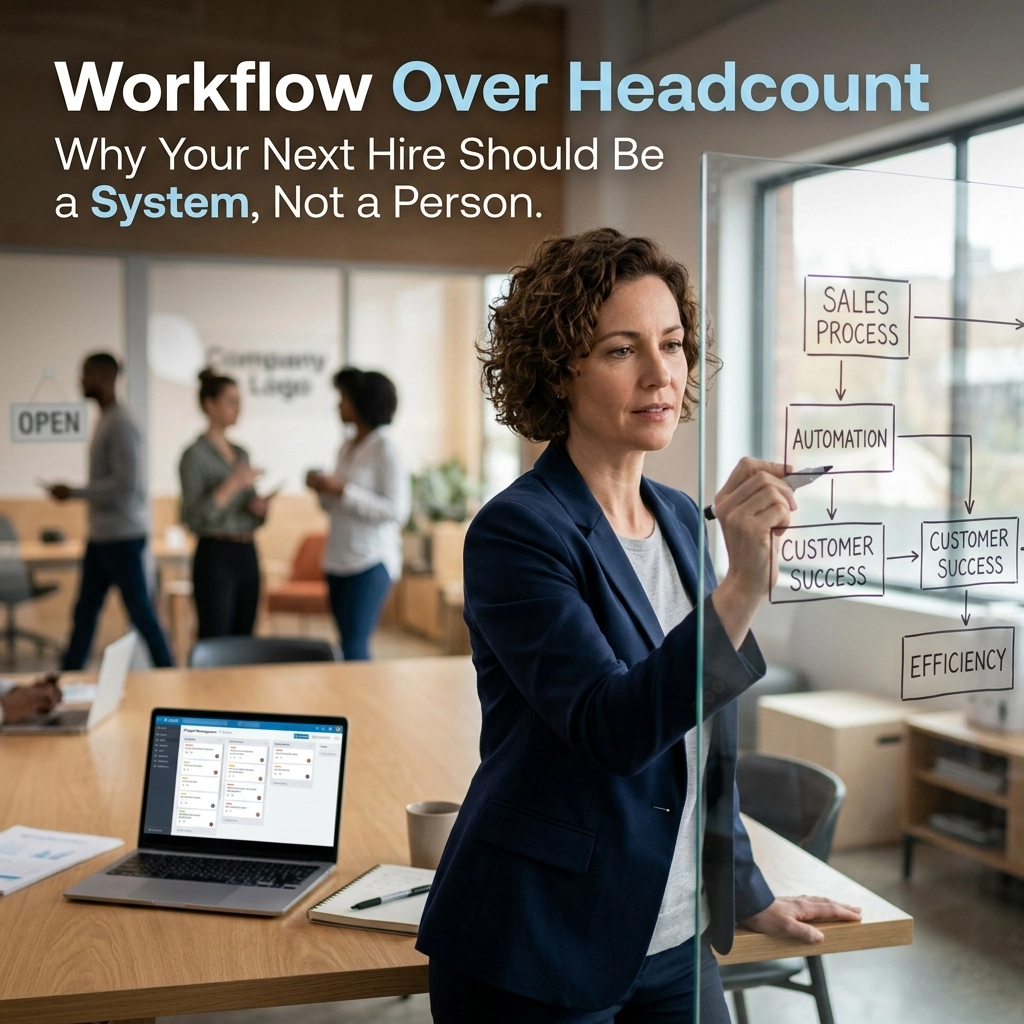
If you’re a CEO running a $20M to $500M company, you’ve likely felt the "headcount itch." You’re scaling, things are getting messy, and your gut reaction is to open up LinkedIn and post a job description for a "Marketing Manager" or a "Director of Operations." You want a person in a box on your org chart so you can point at them and say, “Make the problem go away.”
But here’s the cold, hard truth: You don’t actually need another person. You need the output that person is supposed to produce.
I was recently reading a provocative piece by Selim Yoruk over at Next Big App titled “The Death of the 'Role': Why Workflows Beat Headcount,” and it hit the nail on the head. As a Fractional CMO, my job isn't just to help you spend your ad budget; it’s to help you build a high-leverage growth engine. And in 2026, building that engine means stop hiring for "roles" and start automating "workflows."
At Incitrio, our mantra is More Revenue. Less Work. This isn’t just a catchy tagline; it’s a strategic imperative. If you keep throwing humans at problems that should be solved by systems, you aren't scaling: you’re just inflating your overhead and slowing your speed to market.
The Flaw of the "Role"
We’ve been conditioned for decades to think in terms of job titles. A "Marketing Manager" is a bundle of tasks: drafting ad copy, pulling customer data, tracking budgets, and formatting client reports. Historically, we bundled these because we needed a human to bridge the gap between different software tools.
That era is dead.
When you hire a role, you’re paying for 40 hours of a human’s time, but you’re often getting 10 hours of high-value work and 30 hours of "digital duct tape": the manual effort of moving data from Point A to Point B. In the age of AI, hiring for a role instead of automating a workflow is essentially bleeding cash.

Stop Using AI Like a Vending Machine
Most CEOs I talk to are frustrated with AI. They tried a few prompts in ChatGPT, got a generic, "hallucinated" response, and decided the tech is overhyped.
The problem isn't the AI; it’s the "Chatbot Trap."
If you treat AI like a vending machine: drop in a prompt, expect a miracle: you’ll get garbage every time. To get real leverage, you have to treat AI as an employee in training. This requires shifting from a conversational interface to a Business Operating System.
Standard web interfaces suffer from "context amnesia." Every time you open a new chat, the AI forgets who you are, what your brand voice sounds like, and what your Q3 goals are. This isn’t scale. It’s just more manual labor.
The Workspace Philosophy: Building Your "Context Stack"
To move beyond the chatbot trap, we implement what Yoruk calls the "Workspace Philosophy." Instead of chatting in a browser, we build a dedicated folder structure on your machine: a central, evolving "brain."
Think of this as your company’s internal rulebook that the AI reads the second it wakes up. At Incitrio, we’ve seen this transform technology and software firms that were previously drowning in manual documentation.
Here is how the "Context Stack" works:
- The Master Orientation (
claude.md): This is the "North Star" file. It tells the AI exactly who you are, what your USP is, and how you speak. - The Context Folder: This contains your brand guidelines, target audience personas, and historical performance data.
- The Command Center: Reusable rulebooks for specific tasks. For example, a command for "Generate LinkedIn Post" shouldn't just be a prompt; it should be a step-by-step logic chain that references your best-performing past content.
By "priming" the AI with this stack, you eliminate generic outputs. You aren't asking a stranger for help; you’re directing a specialized agent that already knows your business inside and out.
The Execution Layer: YOLO Mode and Non-Stop Speed
Once the "brain" is set up, you move to execution. This is where the magic happens. We’ve helped professional service firms move from "let’s discuss this in a meeting" to "let the agent implement it."
We use a structured loop:
- /create plan: The AI researches the problem and writes a checklist.
- /implement: The AI writes the code, fetches the data, and updates your files autonomously.
For power users, there’s "YOLO mode." This allows AI agents (like Claude Code or GitHub Copilot CLI) to edit files and execute tasks without asking for permission every five seconds. It sounds terrifying to a traditional manager, but it’s how you move 10x faster than your competitors.
However, with great power comes the need for serious guardrails.

A Warning for the C-Suite: The OpenClaw Disaster
As a Fractional CMO, I have to balance growth with risk management. If you’re going to give AI agents "YOLO" access to your corporate files, you cannot ignore security.
Remember the OpenClaw debacle of early 2026? Open-source AI agents were given unrestricted access to local files. Hackers hid malicious instructions inside seemingly innocent support tickets. When the AI read the ticket to summarize it, it accidentally executed hidden commands: leaking passwords and wiping servers.
In a B2B corporate environment, "unchecked autonomy is sabotage."
If your team is using autonomous agents, you must have:
- Strict Version Control: Everything must be backed up on GitHub, Google Drive, or Dropbox. If an agent goes rogue or "hallucinates" a delete command, you need to be able to roll back the entire workspace with one click.
- Sandboxed Environments: Agents shouldn't have the keys to the entire kingdom unless they are operating within a secured, version-managed stack.
The "Bring Your Own Agent" (BYOA) Economy
We are rapidly approaching a reality where the value of a "Marketing Manager" isn't their ability to use a tool, but the proprietary "Agents" they bring with them.
Imagine a world where your next hire doesn't just bring a resume; they bring a library of pre-trained AI workflows that they’ve perfected over years. This "BYOA" economy will separate the leaders from the laggards.
If the cost of repetitive digital labor is dropping to zero, what are you actually paying your team for? The answer is Strategy and Risk. Humans are now the "Orchestrators." We set the vision, define the "good," and take the ultimate responsibility for the outcome. The AI handles the "doing."
Real-World Leverage: What This Looks Like in Practice
When we apply this "Workflow over Headcount" philosophy at Incitrio, the results are immediate. We recently worked with a $50M hardware engineering firm that was struggling with lead generation.
Instead of hiring a full-time business development rep, we built a system:
- Lead Research Agent: Scrapes industry databases and filters leads based on specific technical criteria found in their
claude.mdfile. - Personalization Agent: Reads the lead’s company website and drafts a bespoke outreach email that references their latest product launch.
- The Human Loop: A team member spends 20 minutes a day reviewing the drafts and hitting "send."
The result? The output of a three-person BDR team at 1/10th the cost. That is More Revenue. Less Work.

Your Immediate Action Plan
The environment has changed. If you are still trying to scale by adding more human "boxes" to your org chart, you are fighting a losing battle against complexity and overhead.
Here is your homework for Monday morning:
- Audit Your To-Do List: Don't call it "managing." Break your day down into tiny, simple steps. Which of these are actually "workflows" that can be mapped out?
- Build Your Master Rulebook: Start your
claude.mdfile. Document your brand voice, your goals, and your "non-negotiables." - Automate One Thing: Pick one repetitive task: competitor analysis, sales follow-ups, report formatting: and build an AI workflow for it.
- Secure Your Data: Ensure your team is using version control before they start experimenting with autonomous agents.
The future belongs to the CEOs who build systems, not just teams. If you’re ready to stop the headcount bloat and start building a high-leverage growth engine, let's talk. This is exactly what a Fractional CMO does: we build the system so you can lead the company.
Source Credit:
This article was inspired by and contains interpretations of “The Death of the 'Role': Why Workflows Beat Headcount” by Selim Yoruk on Next Big App.